Table Of Content

These boundaries are wonderfully complex structures in themselves and self-organize into larger patterns (doors or windows that become shared types over time, and neighborhoods that develop characteristic interface patterns of porches or colonnades). Just as biological structures and computer algorithms spontaneously repeat their geometric patterns at different scales, so do we, unless we’re forced to do otherwise either by legislation or by ideology. Individuals might make small repetitions of a pattern (a rectangular room shape) while groups might make larger versions of the same pattern (a courtyard) and larger groups might make a still larger one (an urban plaza). The Fractal Design Define 7 features a dual layout design that, while configured in the standard "open" layout, can accommodate up to three 3.5 -inch hard drives and four 2.5-inch drives simultaneously. The alternate "server" layout allows you to add an additional eight hard drive mounting locations in the main compartment, though only four hard drive caddies are included from the factory. An optional hard drive tray kit can be purchased separately for $10 / £9.29 from Fractal Design.
Presenting North XL
The GPU thermals put the Define 7 actually very near the top of the chart. This, we think, is again because of the GPU intake through the rear of the case as a result of the pressure system being created. The front panel of the case is a sticking point for us, as it always is with Fractal’s non-Meshify cases, but we’ll save most of that discussion for the thermal and noise testing sections.
GN Case Testing Bench
The time required for higher-level exchange is therefore used more effectively, and the net effect is a synergy of activities that often translate into economic, social, and other benefits. Fractal’s Define 7 stock performance runs toward the bottom of the cases, and is one of the worst we’ve tested recently. It’s unfortunate, but the positive side is that opening the door isn’t really a modification or a deviation from how the case is intended to be used. The takeaway is basically that, if you’re running a high power workload, you should open the door. Stock performance is nearing Bitfenix Enso levels of terrible, and that’s all because of the door. With the door open -- again, no removal of panels required -- it’s down to 53 degrees over ambient.
Define 7 XL
At 25.8 delta T over ambient, we don’t really have anything to complain about or to praise. The CPU thermals ar ehigh, though, at 31 degrees versus neighboring results of 27, 22, and 28 degrees over ambient. It’s toward the top of our truncated chart, with the RV02, H500 blank Mesh, and H710 all nearby. For a gaming-style workload, the Define 7 does fine and doesn’t need the door to be opened on our bench.
Cable management
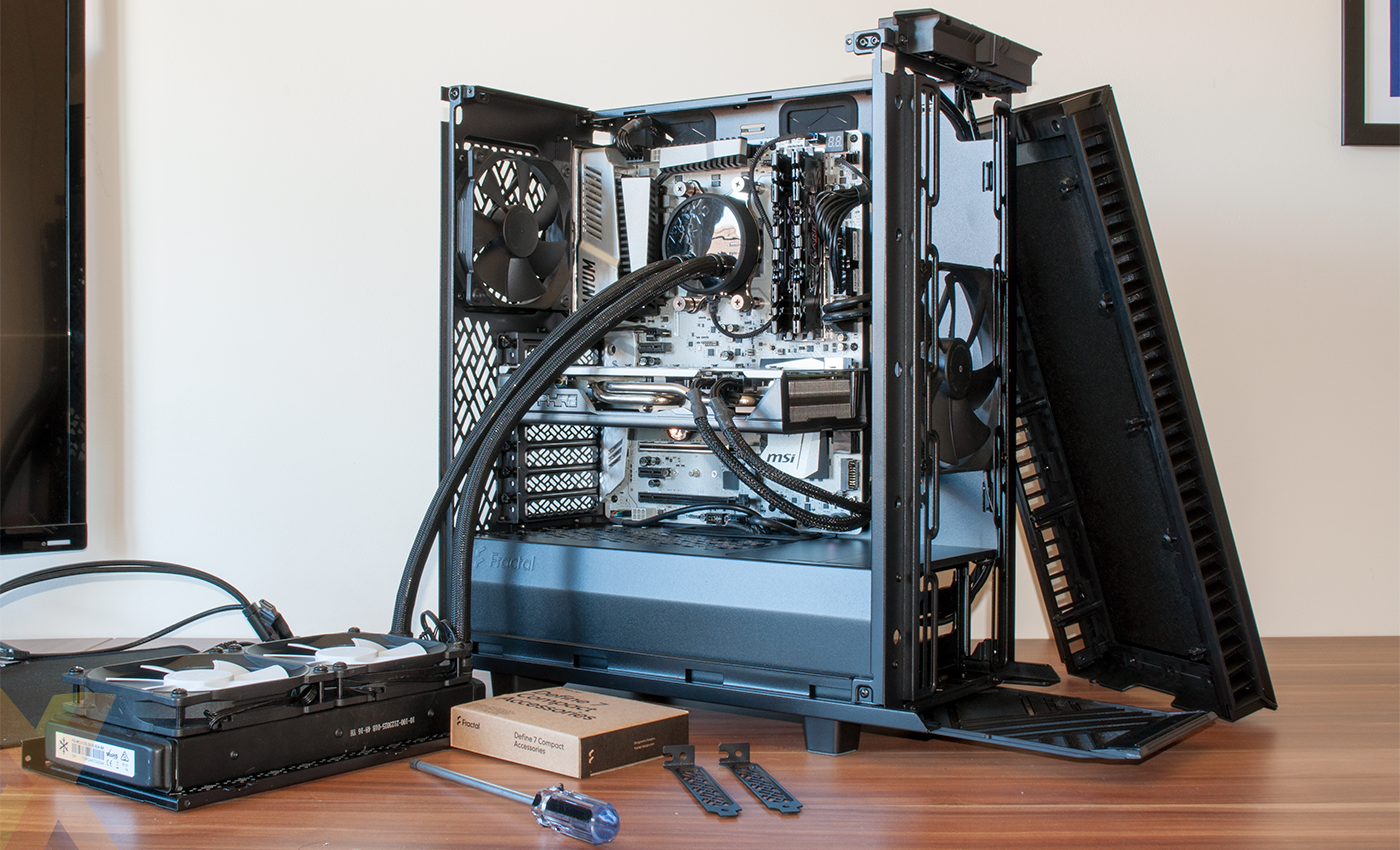
We always appreciate removable radiator trays, but this one should make working with tubing especially easy. In this review we will be looking at the opposite of a small form factor case and what could be called the latest and most comprehensive iteration of the Define series from Fractal Design. This case builds on previous case designs while still keeping with the company directives focusing on build quality, silent operation and versatility with modern minimalist aesthetics. During Computex in 2015 I met with them on what I would call a “speed date”. This one day media event was staged in a local restaurant allowing people to eat and drink until your meeting.
Fractal Define 7 Case Review: High Build Quality & Thermal Challenges
Fractal Design Define 7 Compact review - guru3d.com
Fractal Design Define 7 Compact review.
Posted: Tue, 04 Aug 2020 07:00:00 GMT [source]
Now, of course, a higher power load configuration might be different, so keep in mind that big overclocks or poor GPU coolers would potentially change this statement. The new Define 7 Compact takes the strongest features of the contemporary 7 Series design and places them in a conveniently compact frame. Nikos A. Salingaros is a mathematician and polymath known for his work on urban theory, architectural theory, complexity theory, and design philosophy. He has been a close collaborator of the architect and computer software pioneer Christopher Alexander. Salingaros published substantive research on Algebras, Mathematical Physics, Electromagnetic Fields, and Thermonuclear Fusion before turning his attention to Architecture and Urbanism. He still is Professor of Mathematics at the University of Texas at San Antonioand is also on the Architecture faculties of universities in Italy, Mexico, and The Netherlands.
Most of the air that the GPU pulls is coming through the rear PCIe slot covers and vertical PCIe slot covers, which is unaffected from front panel changes. All of that extra air intake from the front goes straight to the CPU. There are some small frequency steps in some of these, but nothing significant.
Substantial cooling
Fractal Design's White, No-Glass Define 7 Compact is a Minimalists Dream Case - Tom's Hardware
Fractal Design's White, No-Glass Define 7 Compact is a Minimalists Dream Case.
Posted: Thu, 08 Oct 2020 07:00:00 GMT [source]
The panel isn’t nearly as ventilated as it could be, but Fractal has a focus on noise damping in their cases, and noise versus thermals is always a delicate balance to strike. As long as Fractal doesn’t advertise this as an “airflow” case and sticks to its noise-focused advertising, we don’t need to be as aggressive on the panel choices. It’s when companies mismarket their products that it’s a huge problem. The front is only held closed with a magnet and hinges open easily to reveal the front filter, so running the case with the door open during intense workloads isn’t out of the question. The hinges are constructed of metal and are therefore potentially sturdier than the ones found in the Dark Base Pro 900, but they’re still fairly delicate and mounted to a plastic frame, so we expect this to be a point of failure. There are also two dedicated 2.5-inch SSD brackets behind the motherboard tray.
Specifications and Features

The front I/O still includes a full complement of four USB type A ports (two 3.0 and two 2.0) as well as a USB C port and separate mic and headphone jacks. The PSU attaches to a frame and is inserted into the rear of the case, which is fairly common but always an appreciated feature in cases with PSU shrouds. The top radiator mount is a removable tray, but even more so than usual, allowing most of the top of the case to be lifted off rather than just a discrete tray.
Inside the box you will find four additional hard drive caddies, an additional vented top panel, a small box containing various screws and the user manual. Interchangeable top covers allow you to switch between solid steel for full noise suppression or a ventilated cover for extra cooling. With its bold and innovative design, it sets a new standard for what you should expect from a full tower case in terms of modularity, flexibility and ease of use. Supporting the largest E-ATX and enterprise boards, multi-GPU setups, and almost two dozen storage devices (in Storage layout), you’ll be hard pressed to find a limit to what you can do with your build in the Define 7 XL. On the left is the highly fractal structure of urbanism in Bruges, Belgium. On the right, a much more sparse, fractal-free environment in the modern suburbs of Bruges—which is also far less walkable, and has other negative impacts.
The exhaust fan mounting location features slotted screw holes that lets you adjust the position of the fan to fine tune airflow or make room for system components. Thanks to an adaptable dual-layout interior, the Define 7 can easily accommodate motherboards all the way up to 285 mm E-ATX, extensive storage arrays with up to 14 HDDs, 4 SSDs and an ODD bay, and robust cooling with a 420 mm radiator and up to nine fans. Our standardized fan testing is next, where we replace the fans with a defined set of Noctua fans, including two 140mm front fans and one 120mm rear fan. We keep the fans in the same positioning as stock when possible, as it is here, and we also mark each fan so we know which of the two front fans goes in the top versus the bottom, as their natural RPM manufacturing variance will matter for this.



No comments:
Post a Comment